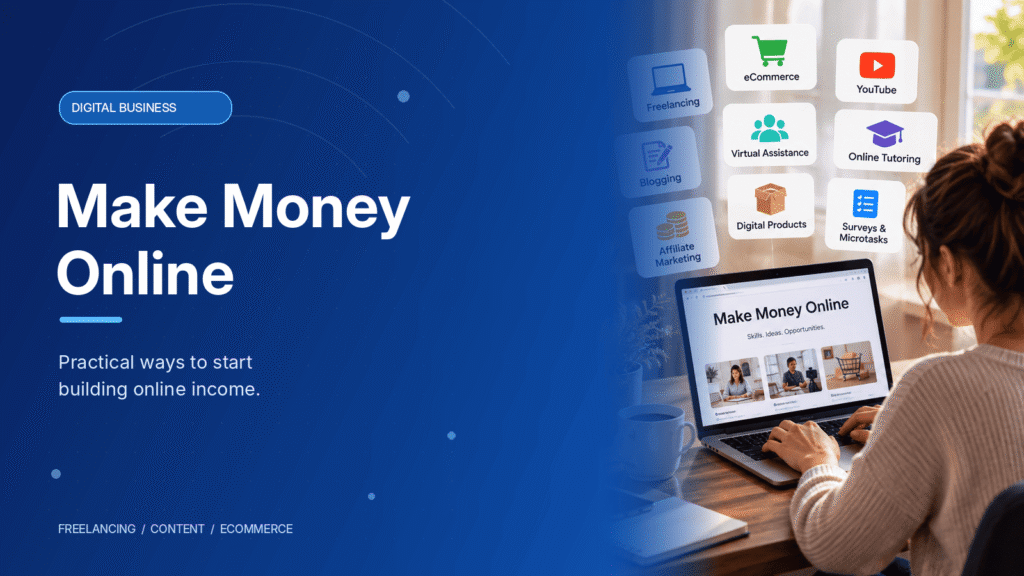
Learning how to make money online doesn’t require a complicated business plan or a large investment. You can earn by offering services, selling products, teaching skills, or creating content that attracts an audience.
However, not every opportunity is equally profitable or suitable for beginners. Freelancing may generate income relatively quickly once you find clients, while blogging, affiliate marketing, and online stores often require more time and investment.
This guide explains nine legitimate ways to earn money online, what each involves, and how to choose the right starting point.
Which Online Income Method Is Right for You?
Before choosing an opportunity, consider your skills, available time, and budget.
| Method | Startup Cost | Earning Potential |
|---|---|---|
| Freelancing | Low | Depends on skills and clients |
| Virtual assistance | Low | Based on hours or contracts |
| Online tutoring | Low | Based on subject and demand |
| Digital products | Low to medium | Depends on sales |
| Blogging | Low to medium | Slow to build, potentially scalable |
| Affiliate marketing | Low | Depends on audience and conversions |
| eCommerce | Medium or higher | Depends on margins and sales |
| YouTube | Low to medium | Audience-dependent |
| Surveys and microtasks | Usually free | Generally limited |
These are broad comparisons, not income guarantees. Your results will depend on demand, competition, expenses, and the quality of your work.
1. Freelancing: Sell Your Skills
Freelancing is one of the most practical ways to start earning online if you already have a marketable skill.
Businesses hire freelancers for writing, graphic design, website development, translation, video editing, and digital marketing.
Platforms such as Upwork and Fiverr connect freelancers with potential clients.
How to get started: Choose one service, prepare two or three portfolio samples, and create a clear offer explaining what customers will receive.
Focus on delivering quality work and building long-term client relationships rather than competing solely on price.
2. Virtual Assistance: Support Businesses Remotely
Virtual assistants (VAs) help businesses and entrepreneurs with administrative tasks.
Common services include email management, appointment scheduling, data entry, customer support, and social media coordination.
You don’t necessarily need advanced technical skills, but organization, communication, and reliability are essential.
How to get started: Identify the tasks you’re comfortable performing and offer a focused service package.
For example, you could manage customer inquiries and appointment scheduling for small businesses.
3. Online Tutoring: Teach What You Know
If you’re knowledgeable in a particular subject, online tutoring can turn that expertise into income.
Popular subjects include mathematics, English, programming, science, and foreign languages.
Platforms such as Preply connect tutors with learners, although eligibility, fees, and teaching requirements vary.
How to get started: Choose a subject, identify your target students, and prepare a simple lesson structure.
You can also offer tutoring independently, although finding students and managing payments becomes your responsibility.
4. Sell Digital Products
Digital products can be sold repeatedly without manufacturing physical inventory.
Examples include:
- E-books and educational guides.
- Website templates and design assets.
- Digital planners and spreadsheets.
- Online courses and downloadable resources.
You can sell through marketplaces or your own website.
How to get started: Identify a problem your audience faces and create a small product that solves it.
Digital products can scale, but they aren’t automatically passive income. Customer support, marketing, updates, and refunds still require attention.
5. Start a Blog or Newsletter
Blogging allows you to build an audience around subjects you understand well.
Successful blogs typically focus on helping a specific audience, whether through tutorials, product comparisons, or practical advice.
Common monetization methods include display advertising, affiliate commissions, sponsorships, and selling your own products.
To build an independent website, you can use WordPress with suitable WordPress hosting.
Our WordPress hosting tips guide explains how to choose an appropriate hosting environment.
How to get started: Select a focused niche, research common reader questions, and publish useful content consistently.
Blogging usually takes time to attract visitors, so don’t assume it will generate meaningful income immediately.
6. Affiliate Marketing: Earn Commissions from Referrals
Affiliate marketing involves recommending products or services and earning a commission when qualifying purchases or other specified actions occur.
For example, a technology blogger might recommend hosting services, software, or equipment relevant to their readers.
Some companies operate direct affiliate programs, including ZYNOO’s web hosting affiliate program.
How to get started: Build an audience, select products you understand, and publish helpful recommendations.
Always disclose affiliate relationships clearly and follow applicable advertising rules.
Affiliate marketing works best when recommendations are relevant and trustworthy rather than purely promotional.
7. Build an Online Store
An online store lets you sell physical products directly to customers.
You can manage your own inventory, work with suppliers, or use a dropshipping model where a third party fulfills orders.
Platforms such as Shopify and WooCommerce provide tools for managing product listings, payments, and orders.
If you prefer WordPress, WooCommerce hosting can provide the foundation for your online store.
How to get started: Research customer demand, calculate your margins, and test a small product range.
Remember to account for advertising, payment processing, shipping, returns, and supplier reliability.
Dropshipping removes the need to hold inventory, but it doesn’t eliminate customer service or business risk.
8. Create Videos and Build a YouTube Channel
YouTube allows creators to earn through advertising, memberships, sponsorships, affiliate recommendations, and product sales.
Popular subjects include tutorials, technology, gaming, education, and product reviews.
However, building an audience requires consistent effort.
YouTube’s Partner Program has eligibility requirements that vary by monetization feature, including subscriber and viewing thresholds.
How to get started: Choose a subject you can cover consistently, create useful videos, and study which topics your audience responds to.
Treat YouTube as a long-term content project rather than an immediate source of income.
9. Complete Online Surveys and Microtasks
Surveys, usability testing, and microtasks offer simple ways to earn smaller amounts online.
Tasks may involve reviewing websites, providing feedback, categorizing information, or answering market research questions.
Availability and payment vary by platform, location, and eligibility.
How to get started: Research established platforms, review their payment terms, and calculate whether the compensation is worth your time.
These opportunities generally work better for supplemental income than building a full-time business.
How to Start Making Money Online
Choosing an opportunity is only the beginning. A simple plan can help you avoid wasting time and money.
Step 1: Choose one method. Focus on something that matches your existing skills, resources, and available time.
Step 2: Validate demand. Look for real customers, existing competitors, and problems people are willing to pay to solve.
Step 3: Start small. Offer one service, publish a few articles, or launch a limited product range before making major investments.
Step 4: Track your results. Measure revenue, costs, time invested, and customer feedback. Adjust your approach based on evidence rather than promises of quick income.
How to Avoid Online Money-Making Scams
Not every advertised online opportunity is legitimate.
Be cautious of offers promising guaranteed earnings, unusually high pay for simple tasks, or substantial income without effort.
Protect yourself by following a few basic rules:
- Never pay someone simply to unlock a job or receive your earnings.
- Research unfamiliar employers and platforms before sharing personal information.
- Be suspicious of unsolicited job offers through messaging apps.
- Avoid schemes requiring cryptocurrency deposits to withdraw supposed profits.
- Use trustworthy payment methods and keep appropriate transaction records.
Legitimate online work requires effort, customers, or real value—not mysterious systems promising easy money.
Frequently Asked Questions
Yes. Virtual assistance, entry-level freelancing, tutoring, and certain microtasks may be accessible to beginners. However, you still need to develop useful skills and find legitimate opportunities.
Selling an existing skill or service is often more direct than building an audience-based business. The time needed to find your first paying customer varies.
Some digital products, affiliate content, and online businesses can continue generating sales after the initial work. However, marketing, maintenance, and customer support usually remain necessary.
Not always. Freelancers, tutors, and content creators can begin using existing platforms. An independent website becomes useful when you want greater control over your brand, content, and customer relationships.
Conclusion
There are legitimate ways to make money online, but the best opportunity depends on your skills, available time, and willingness to learn.
Freelancing and service-based work offer a practical starting point for many beginners. Blogging, affiliate marketing, and eCommerce can develop into larger businesses, but they usually require more patience and preparation.
Start with one realistic opportunity, test whether people will pay for it, and build from there.