What is reseller hosting? Reseller hosting is a business model that allows individuals and companies to sell web hosting services under their own brand without owning or maintaining physical servers. You purchase hosting resources from a provider, create your own packages, and charge customers your chosen prices.
It’s particularly useful for web designers, digital agencies, and hosting companies looking to generate recurring revenue from their existing customers.
But reseller hosting isn’t just one type of service. You can resell traditional shared hosting accounts or individual virtual private servers (VPS), depending on your business and customers.
Let’s explore how reseller hosting works, what it costs, and which approach makes the most sense.
How Does Reseller Hosting Work?
Reseller hosting involves three parties: the infrastructure provider, the reseller, and the end customer.
Here’s a typical setup:
- The hosting provider operates the physical servers, networking, and underlying infrastructure.
- You, the reseller, purchase hosting services, create packages, and sell them under your business name.
- Your customers purchase hosting through your website and contact your business for billing and support.
For example, imagine you run a web design agency with 20 clients. Rather than sending each client to a different hosting provider, you can offer hosting directly and manage their subscriptions alongside your website services.
You manage the customer relationships while your infrastructure partner handles the underlying servers.
However, you’re still responsible for customer support, billing, and delivering the services you’ve promised.
Types of Reseller Hosting
There are two common approaches worth understanding before starting a hosting business.
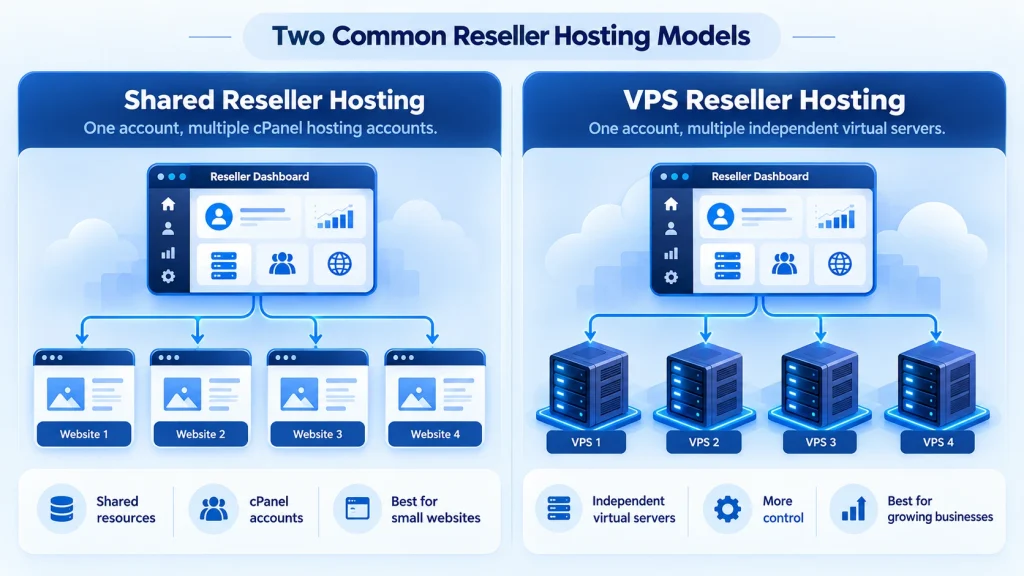
1. Shared Reseller Hosting
Traditional reseller hosting allows you to divide an allocated hosting environment into separate customer accounts.
Most providers use cPanel and Web Host Manager (WHM). WHM allows resellers to create accounts, assign storage and bandwidth limits, and manage hosting packages.
Each customer typically receives their own cPanel account for managing website files, email, databases, and domains.
This approach is suitable for web designers, freelancers, and agencies hosting relatively small websites.
However, you’re still operating within the provider’s shared infrastructure and resource restrictions.
2. VPS Reseller Hosting
VPS reseller hosting works differently. Instead of selling shared hosting accounts, you resell individual virtual private servers.
Each customer receives an independent virtual server with allocated resources and its own operating system.
This makes VPS reselling attractive for customers who need greater flexibility, administrative access, or more demanding application environments.
For example, a development agency might offer Linux VPS hosting for business applications and Windows VPS hosting for customers requiring Windows-based software.
Shared vs VPS Reseller Hosting: Quick Comparison
| Feature | Shared Reseller Hosting | VPS Reseller Hosting |
|---|---|---|
| What you sell | Individual website hosting accounts | Independent virtual servers |
| Typical management | WHM and cPanel | VPS control panel, WHMCS, or API |
| Customer control | Limited hosting account access | Root or administrator access, depending on plan |
| Ideal customers | Small websites, bloggers, agencies | Developers, growing businesses, applications |
| Resource model | Shared hosting allocation | Resources allocated to each VPS |
| Technical requirements | Generally lower | Higher for unmanaged server support |
Neither option is automatically better. The right choice depends on what your customers need and how much technical support your company can provide.
Benefits of Reseller Hosting
Generate Recurring Revenue
Hosting is commonly billed monthly or annually, allowing you to build recurring income from customer renewals.
You can also offer complementary services such as website maintenance, migrations, monitoring, and backups.
Avoid Infrastructure Investment
Building your own hosting infrastructure requires servers, networking equipment, virtualization software, and ongoing maintenance.
Reseller hosting lets you start without purchasing physical hardware, reducing your initial investment and infrastructure responsibilities.
Grow Your Own Brand
White-label reseller programs allow you to sell hosting under your company name.
You manage your pricing, customer communication, and service offerings while your provider operates behind the scenes.
Keep Existing Customers
Web designers and agencies often lose ongoing customer relationships when projects are handed over to external hosting companies.
Offering hosting alongside development and maintenance can help you provide a more complete service and retain customers longer.
How Much Does Reseller Hosting Cost?
The cost depends on the hosting model, allocated resources, software requirements, and your provider’s pricing structure.
Traditional shared reseller hosting often involves a fixed monthly package with limits on storage, bandwidth, or customer accounts.
VPS reseller programs may charge for each active virtual server, with discounts based on volume.
Your selling price should cover more than the hosting purchase cost.
For example, suppose your monthly reseller package costs $60 and you host ten customers paying $12 each.
| Item | Monthly Amount |
|---|---|
| Revenue from 10 customers | $120 |
| Reseller hosting cost | $60 |
| Gross difference | $60 |
This leaves $60 before payment processing, billing software, customer support, taxes, and other expenses.
It’s a simplified illustration, not a guaranteed profit.
The most profitable hosting package isn’t necessarily the cheapest one. Your margins depend on providing a service customers value while keeping your operating costs under control.
Who Should Consider Reseller Hosting?
Reseller hosting can work well for several types of businesses.
Web design agencies: Bundle hosting with website development and maintenance.
Freelancers: Offer hosting as an additional service to clients who already trust your technical expertise.
Existing hosting companies: Expand into VPS services without purchasing virtualization nodes.
IT service providers: Provide hosting alongside application support, monitoring, or infrastructure management.
If you only need to host your own website, regular shared hosting or a VPS is usually more appropriate.
Reseller hosting makes the most sense when you intend to manage hosting services for multiple customers.
How to Choose a Reseller Hosting Provider
Before committing to a provider, evaluate these five essentials:
- Infrastructure reliability: Check uptime commitments, network quality, and resource specifications.
- White-label capabilities: Confirm what your customers see and which elements can carry your branding.
- Automation: Look for WHMCS integration, API access, or compatible provisioning tools.
- Technical support: Understand who handles infrastructure problems and who supports the end customer.
- Transparent pricing: Review licensing fees, resource limits, reseller discounts, and renewal terms.
Also verify how backups, security incidents, upgrades, and customer cancellations are handled.
These details become increasingly important as your customer base grows.
Start Reselling VPS with ZYNOO
For hosting companies looking to expand beyond shared hosting, ZYNOO offers a dedicated VPS Reseller Program.
The program allows you to sell Linux and Windows VPS hosting under your own brand without investing in physical server infrastructure.
Key features include:
- Free enrollment: No reseller account fees, deposits, or minimum commitments.
- White-label hosting: Set your prices and manage your customer relationships.
- Volume discounts: Save 10% to 25% based on your active VPS count.
- WHMCS integration: Use the included module for automated VPS ordering and management.
- REST API: Connect provisioning and server controls to compatible custom platforms.
- Infrastructure support: ZYNOO provides 24/7 assistance with underlying infrastructure issues.
The program focuses on reselling individual VPS services, rather than providing a conventional bundle of shared cPanel reseller accounts.
You pay for the VPS services you order, and separate billing software licenses or customer management expenses may still apply.
Sell VPS Hosting Under Your Own Brand
Free to join, with white-label hosting, automated provisioning, and up to 25% reseller discounts.
Frequently Asked Questions
It can be profitable when your customer revenue exceeds hosting costs and operating expenses. Profitability depends on pricing, customer retention, support costs, and how efficiently you manage your services.
Basic hosting knowledge is strongly recommended. While your provider maintains the underlying infrastructure, you still need to assist customers with hosting issues, account management, and service configuration. VPS reselling may require additional server administration expertise.
Reseller hosting means selling hosting services to your own customers and managing their accounts and billing. Affiliate marketing typically involves referring customers to another hosting provider in exchange for commissions.
Not necessarily. A VPS is an independent virtual server. Installing cPanel generally requires a compatible operating system, sufficient resources, and an appropriate license.
Conclusion
Reseller hosting allows businesses to sell hosting services without building and maintaining their own server infrastructure.
Traditional shared reseller hosting suits smaller website hosting businesses, while VPS reselling provides an opportunity to serve developers, growing companies, and customers needing greater server control.
The right approach depends on your target customers, support capabilities, and pricing strategy.
Start with the services your customers actually need, choose a dependable infrastructure partner, and build your hosting business around long-term customer relationships.