A bare metal server is a physical server dedicated to a single customer, providing exclusive access to its processing power, memory, and storage. Unlike a VPS, which typically shares physical hardware with other virtual servers, bare metal gives you control over an entire machine.
It’s a practical choice for resource-intensive applications, large databases, and businesses that need consistent performance. However, dedicated hardware isn’t always necessary, and understanding the trade-offs can help you avoid paying for resources you don’t need.
How Does a Bare Metal Server Work?
A bare metal server operates on physical hardware assigned exclusively to one customer. The hosting provider supplies the machine, network connectivity, and data center infrastructure, while the customer manages the operating system and applications according to the service agreement.
A typical setup includes:
- Dedicated hardware: CPU, RAM, and local storage aren’t shared with other customers.
- Operating system control: Install a supported Linux distribution, Windows Server, or another compatible operating system.
- Administrative access: Configure applications, security policies, storage, and networking.
- Virtualization options: Run applications directly on the hardware or install a hypervisor to create your own virtual machines.
This flexibility makes bare metal suitable for both traditional server deployments and private virtualization environments.
Bare Metal Server vs. Dedicated Server: What’s the Difference?
Bare metal and dedicated servers are closely related. Both generally refer to physical machines reserved for one customer rather than shared among multiple tenants.
The term bare metal often emphasizes direct hardware access and cloud-style deployment features, such as automated provisioning or API-based management. Traditional dedicated hosting may involve more manual configuration and longer billing commitments.
However, these differences depend on the provider. A dedicated server can offer the same hardware control and performance as a bare metal server.
When comparing hosting plans, focus on the actual specifications, management features, deployment options, and service terms rather than the label.
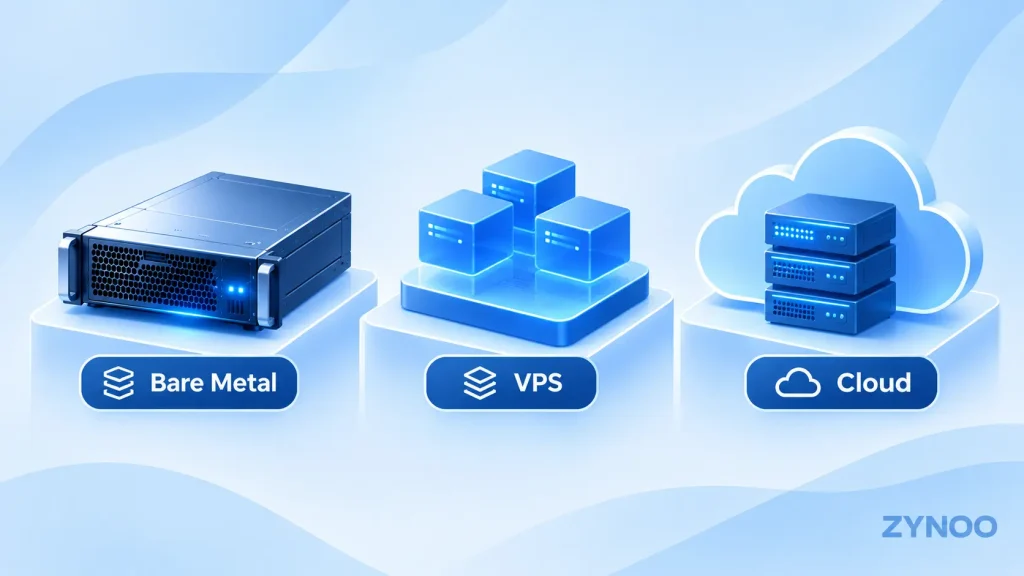
Bare Metal vs. VPS vs. Cloud Hosting
The main differences between these hosting models involve hardware allocation, flexibility, and cost.
| Feature | Bare Metal | VPS | Cloud VM |
|---|---|---|---|
| Physical hardware | Dedicated | Usually shared | Usually shared |
| Resource isolation | Physical | Virtual | Virtual |
| OS control | Full | Typically root/admin | Typically root/admin |
| Scaling | Hardware-dependent | Plan-dependent | Often flexible |
| Provisioning | Varies by provider | Usually fast | Usually fast |
| Entry cost | Generally higher | Lower | Varies by usage |
| Ideal workloads | Sustained, demanding applications | Growing websites and applications | Dynamic workloads |
A VPS is often sufficient for websites, development environments, and moderately demanding applications.
Bare metal becomes more attractive when an application consistently consumes substantial CPU, memory, or disk resources. Cloud virtual machines may be preferable when workloads need rapid scaling or frequent provisioning.
Key Benefits of Bare Metal Servers
1. Dedicated, Predictable Performance
Because physical compute resources aren’t shared with other customers, bare metal avoids resource contention from unrelated tenants on the same machine.
This can improve performance consistency for busy databases, high-traffic applications, and compute-intensive processing. Actual performance still depends on the server specifications, configuration, and workload.
2. Greater Hardware and Software Control
Bare metal provides more flexibility for operating system configuration, kernel tuning, storage layouts, and virtualization.
You can configure RAID where supported, optimize database settings, or deploy your own hypervisor without the restrictions typically associated with a virtual server.
3. Stronger Physical Isolation
A single-tenant server provides hardware-level separation from other customers.
This can be valuable for organizations with demanding security requirements. However, physical isolation doesn’t replace firewalls, access controls, encryption, patching, or compliance procedures.
4. Better Suitability for Sustained Workloads
For applications that run at high utilization throughout the day, dedicated hardware can provide predictable capacity and an attractive long-term cost structure.
Whether it saves money depends on actual resource usage, server pricing, licensing, and management expenses.
When Should You Choose Bare Metal Hosting?
Bare metal is particularly useful for workloads that benefit from consistent access to substantial hardware resources.
High-traffic websites and e-commerce platforms: Applications with large product catalogs, busy databases, or complex backend processing may benefit from dedicated resources.
Database servers: running MySQL, PostgreSQL, and other database systems can benefit from ample memory and fast NVMe storage, especially under sustained I/O workloads.
Game servers: Dedicated hardware can support consistent server processing, although player latency also depends heavily on network routing and geographic location.
Virtualization and private infrastructure: Businesses can use bare metal to host multiple virtual machines, containers, or isolated development environments.
Analytics and compute-intensive applications: Data processing, rendering, and other CPU-heavy workloads can benefit from exclusive access to processor and memory resources.
For smaller websites or applications with occasional traffic spikes, a VPS or cloud instance may be more economical.
What Are the Disadvantages of Bare Metal Servers?
Despite their advantages, bare metal servers have limitations worth considering.
- Higher starting costs: Renting an entire physical machine generally costs more than a small VPS.
- Less immediate scaling: Increasing CPU capacity or replacing hardware may require provisioning or migration.
- Administrative responsibility: Self-managed servers require ongoing updates, security hardening, monitoring, and troubleshooting.
- Hardware failure risk: Dedicated hardware can fail. Backups, redundancy, and recovery planning remain essential.
Importantly, a single bare metal server isn’t automatically more reliable than a well-designed cloud deployment. Availability depends on the overall infrastructure and recovery architecture.
How to Choose the Right Bare Metal Server
Start by identifying your application’s actual resource requirements rather than simply choosing the server with the most CPU cores.
Processor: Prioritize high clock speeds for latency-sensitive applications and more cores for parallel workloads.
Memory: Ensure sufficient RAM for application processes, database caching, and peak usage.
Storage: NVMe SSDs are useful for storage-intensive workloads, while larger-capacity drives may suit backups and archival data.
Network: Check port speed, included traffic, bandwidth limits, DDoS protection, and connectivity to your users.
Management: Confirm whether the server is managed or self-managed, what technical support includes, and who handles backups and operating system maintenance.
Does Server Location Matter?
Yes. Although dedicated hardware improves resource consistency, it cannot eliminate the network latency caused by distance and routing.
For businesses serving European customers, the Netherlands can be an attractive hosting location because of its established data center and network connectivity ecosystem.
Bare Metal Hosting at ZYNOO
ZYNOO offers dedicated server hosting for businesses that need physical hardware, administrative control, and configurations suited to demanding applications.
If your audience is primarily in Europe, you can also explore our Netherlands dedicated servers and compare available hardware, storage, network connectivity, and pricing.
Choose a configuration based on your workload, budget, and management requirements rather than purchasing more capacity than necessary.
Frequently Asked Questions
Not always. Bare metal offers exclusive physical resources and greater hardware control, while VPS hosting is generally more affordable and easier to scale for smaller workloads.
Yes. You can install compatible virtualization software, such as KVM or Proxmox VE, to create and manage virtual machines on your dedicated hardware.
Physical isolation reduces certain shared-infrastructure risks, but security still depends on configuration, updates, access management, and monitoring.
Businesses running demanding databases, high-traffic applications, game servers, or private virtualization platforms are common candidates. Smaller projects typically don’t require an entire physical server.
Conclusion
A bare metal server gives you exclusive access to physical hardware, predictable resource availability, and extensive configuration control. It’s particularly valuable for demanding, long-running workloads, but comes with higher entry costs and greater operational responsibility.
Before choosing one, evaluate your application’s resource usage, expected growth, and management capabilities. The right server is the one that meets your technical requirements without unnecessary expense.