ERR_CONNECTION_RESET is a browser error that occurs when the connection between your device and a website is unexpectedly reset before the page finishes loading. It commonly appears in Google Chrome with the message “This site can’t be reached. The connection was reset.”
The problem may come from your internet connection, browser settings, firewall, VPN, or the website’s server. Fortunately, many connection reset errors can be resolved without advanced technical knowledge.
In this guide, we’ll explain what causes ERR_CONNECTION_RESET and walk through seven practical ways to fix it on Windows, macOS, and web servers.
What Does ERR_CONNECTION_RESET Mean?
When you visit a website, your browser establishes a network connection to exchange data with the server.
The ERR_CONNECTION_RESET message generally indicates that a TCP connection was unexpectedly reset, preventing normal communication.
A connection reset can originate from the destination server, your computer, or an intermediary such as a router, firewall, or proxy.
Common causes include:
- Unstable internet or Wi-Fi connections.
- Incorrect VPN or proxy configurations.
- Firewall or antivirus interference.
- Browser extensions or outdated software.
- Network configuration problems.
- Web server, CDN, or reverse proxy issues.
The first step is determining whether the problem affects your device or the website itself.
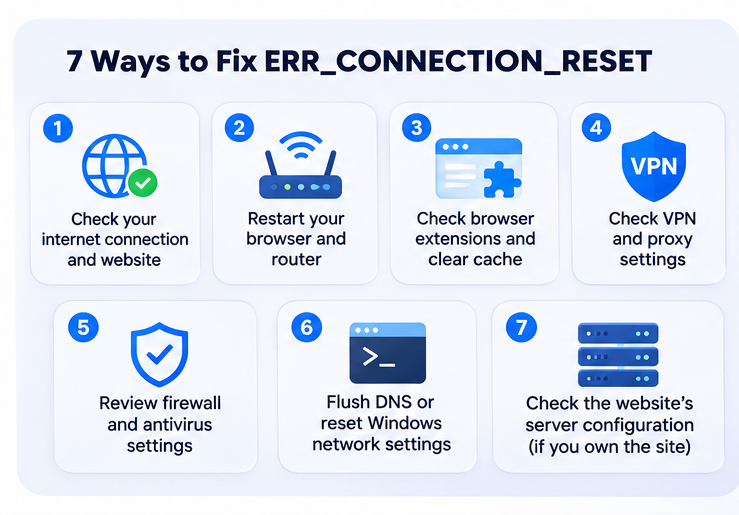
How to Fix ERR_CONNECTION_RESET
Follow these seven troubleshooting methods in order, starting with the simplest solutions.
1. Check Your Internet Connection and Website Availability
First, open another website to see whether your internet connection works normally.
If multiple websites fail, the problem may involve your device, router, or internet service provider.
If only one website displays ERR_CONNECTION_RESET, try opening it on another device or through a different connection, such as mobile data.
These tests help narrow down the cause:
- Works on another network: Investigate your local network, ISP, or security settings.
- Fails on multiple networks: The website or its infrastructure may be responsible.
- Fails only in one browser: Check browser settings and extensions.
These results provide clues, but they don’t conclusively identify the source of the problem.
2. Restart Your Browser and Network Equipment
Temporary network problems can sometimes be resolved by restarting your devices.
Start by closing and reopening your browser. If the error continues, restart your computer.
You can also restart your router and modem:
- Disconnect their power.
- Wait approximately 30 seconds.
- Reconnect the power and allow the internet connection to recover.
- Open the affected website again.
If other devices experience similar connection problems, contact your ISP if restarting the equipment doesn’t help.
3. Check Browser Extensions and Cached Data
Browser extensions can interfere with website connections, particularly those that modify network requests or traffic.
In Google Chrome, open an Incognito window using Ctrl + Shift + N on Windows or Command + Shift + N on macOS.
Try opening the affected website.
If it works, visit chrome://extensions and temporarily disable your extensions. Re-enable them individually to identify any conflicts.
You can also clear cached browser data:
- Open Chrome Settings.
- Navigate to Privacy and security → Delete browsing data.
- Select cached images and files.
- Clear the selected data and try the website again.
Clearing cookies may also help with certain browser problems, but it can sign you out of websites. Start with cached files first.
Keep Chrome updated to avoid compatibility problems caused by outdated browser software.
4. Check VPN and Proxy Settings
VPNs and proxy servers route traffic through additional network services. Incorrect configurations can sometimes interrupt connections.
If you use a personal VPN, briefly test the affected website without it on a trusted network, then restore your preferred connection settings.
For proxy settings:
On Windows 11:
- Open Settings → Network & internet → Proxy.
- Review the automatic and manual proxy settings.
- Correct any unexpected configuration.
On macOS:
- Open System Settings → Network.
- Select your active network connection.
- Click Details → Proxies.
- Review the configured proxy services.
Don’t disable proxies or VPNs required by your workplace or organization. Contact your network administrator if those settings are centrally managed.
5. Review Firewall and Antivirus Settings
Firewalls and antivirus software sometimes block legitimate traffic or interfere with HTTPS connections.
On Windows, open:
Windows Security → Firewall & network protection
Review whether the affected application is being restricted by a firewall rule.
If your antivirus includes HTTPS scanning or web filtering, check its logs for blocked connections.
Avoid turning off Windows Firewall or disabling antivirus protection to bypass the error. Correct the relevant rule or configuration instead.
On managed business networks, ask your network administrator to investigate possible security policy conflicts.
6. Flush DNS and Reset Windows Network Settings
If the error persists across several websites, Windows network configuration problems may be involved.
Start by flushing the local DNS resolver cache.
Open Command Prompt and run:
ipconfig /flushdnsThis removes cached DNS records. It can help when outdated DNS information points your browser toward an incorrect destination, although it doesn’t directly repair a TCP connection reset.
If you’re still experiencing widespread connectivity problems, open Command Prompt as administrator and run:
netsh winsock resetRestart Windows afterward.
This command resets the Windows Winsock catalog, which manages certain network communication components.
Because resetting Winsock can affect networking software and custom configurations, reserve it for persistent problems after simpler troubleshooting has failed.
If you’re using a company-managed computer, consult your administrator before resetting network settings.
7. Check the Website’s Server Configuration
If you own the affected website, the problem may originate from your hosting infrastructure.
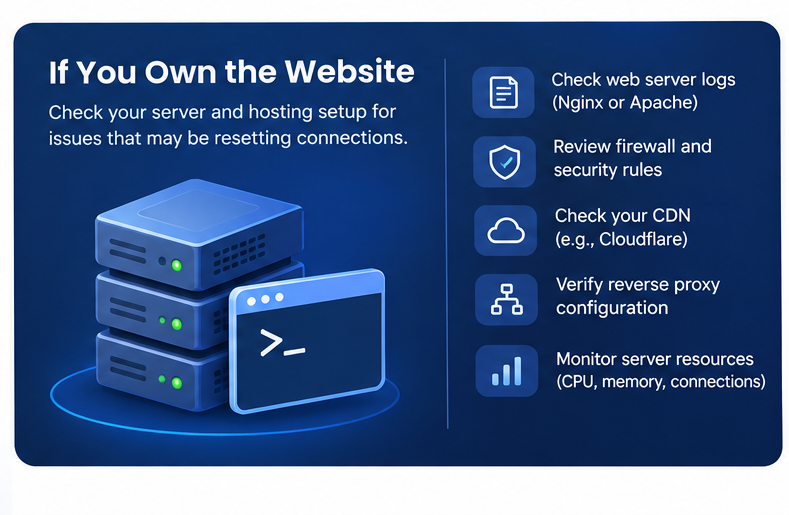
Website administrators should investigate:
- Web server logs: Check Apache or Nginx errors and unexpected service restarts.
- Firewall rules: Review blocked IP addresses, rate limits, and security policies.
- CDN configuration: Examine Cloudflare or another CDN for connection errors and blocking rules.
- Reverse proxy settings: Look for upstream connection failures or application crashes.
- Server resources: Monitor CPU, memory, and connection limits during the failures.
For example, on a Linux server running Nginx, you can inspect recent error log entries:
sudo tail -n 50 /var/log/nginx/error.logFor Apache on Debian or Ubuntu, the equivalent command is commonly:
sudo tail -n 50 /var/log/apache2/error.logLog locations vary according to the operating system and web server configuration.
You can also test an HTTPS connection using:
curl -Iv https://example.comReplace example.com with your domain. The output can help identify connection failures or HTTP response problems, but may not reveal which network component caused a reset.
If your website runs on a VPS, investigate recent configuration changes and contact your hosting provider when the evidence suggests an infrastructure-level issue.
ERR_CONNECTION_RESET vs Other Browser Errors
Not every website connection failure has the same cause.
For example, ERR_CONNECTION_RESET generally concerns an interrupted network connection.
Understanding the exact error helps you avoid unnecessary troubleshooting steps.
Frequently Asked Questions
The error appears when Chrome’s connection to a website is unexpectedly reset. Possible causes include unstable networks, VPNs, security software, or web server configuration problems.
Yes. A website’s server, firewall, reverse proxy, or CDN can interrupt connections. If the problem affects several visitors across different networks, server-side troubleshooting becomes particularly important.
Sometimes, if outdated DNS information contributes to the connection problem. However, DNS flushing won’t fix a server rejecting connections or a firewall resetting them.
Not necessarily. It generally indicates a network connection problem rather than a security breach. However, investigate unexpected firewall, proxy, or security software behavior instead of disabling protection.
Conclusion
ERR_CONNECTION_RESET can be frustrating, but identifying where the connection fails makes troubleshooting much easier.
Start by checking your internet connection, restarting your devices, and reviewing browser extensions. If the problem continues, investigate VPN settings, firewall rules, and Windows networking.
For website owners, server logs, firewall configurations, and reverse proxy settings are important places to look.
The best approach is to start with simple, low-risk checks and move to advanced troubleshooting only when necessary.