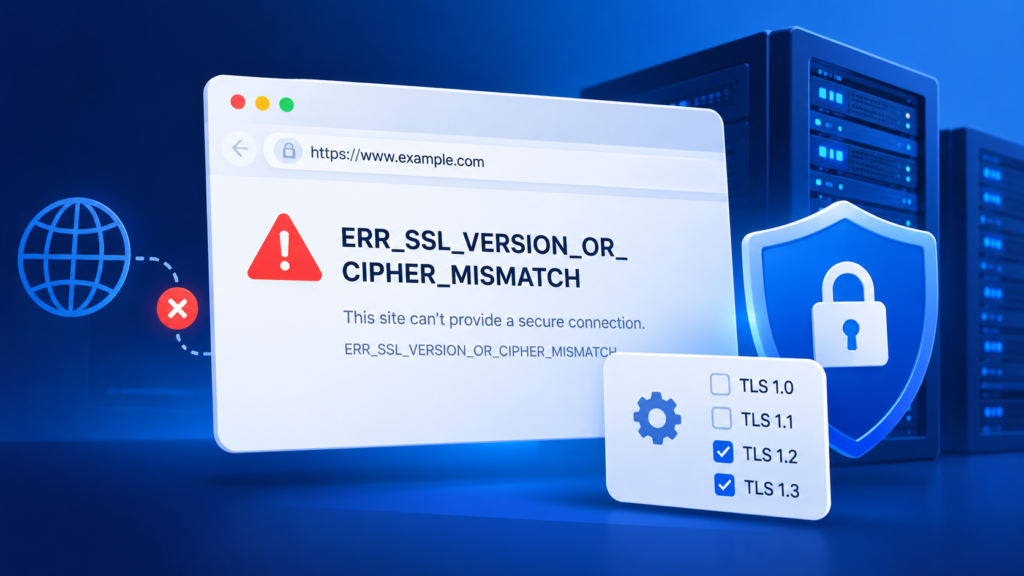
The ERR_SSL_VERSION_OR_CIPHER_MISMATCH error appears when Google Chrome cannot establish a secure HTTPS connection with a website. It usually indicates that the browser and server cannot agree on compatible encryption settings, although certain SSL certificate and CDN configuration problems can also trigger it.
If you’re visiting a website, the problem may be outside your control. If you manage the website, you’ll need to check its SSL/TLS configuration.
This guide explains what causes the error and how to fix it safely.
What Does ERR_SSL_VERSION_OR_CIPHER_MISMATCH Mean?
When you open an HTTPS website, your browser and the server perform a TLS handshake. During this exchange, they negotiate an encryption protocol and cipher suite before securely transmitting website data.
If they cannot establish a compatible connection, Chrome may display:
ERR_SSL_VERSION_OR_CIPHER_MISMATCH
Firefox may show a different message, such as SSL_ERROR_NO_CYPHER_OVERLAP.
Modern websites should support TLS 1.2 and preferably TLS 1.3. Older protocols, including TLS 1.0 and TLS 1.1, are no longer supported by modern browsers.
The error doesn’t necessarily mean a website has been hacked. It means the browser couldn’t establish the expected secure connection.
What Causes This SSL Error?
Several issues can prevent an HTTPS connection from working.
- Outdated TLS protocols: The server supports only encryption protocols that modern browsers reject.
- Incompatible cipher suites: The browser and server have no mutually supported encryption algorithms.
- Certificate configuration problems: The server or CDN doesn’t present an appropriate certificate for the requested hostname.
- Cloudflare configuration: A certificate may still be activating, or a subdomain may not be covered by the current certificate.
- Outdated client software: An older browser, operating system, or network security product may not support the server’s encryption settings.
The correct solution depends on where the problem originates.
How to Fix ERR_SSL_VERSION_OR_CIPHER_MISMATCH
1. Check Whether the Problem Affects One Website
First, determine whether the error appears on one website or multiple websites.
If only one website fails, the issue is more likely related to its server, certificate, or CDN configuration.
If several unrelated websites fail, check your browser, operating system, network connection, and security software.
Try opening the affected website in another updated browser or on another device. This simple test can help narrow down the cause.
2. Check the Website’s SSL Certificate
If you manage the website, start by checking its public SSL/TLS configuration.
Use the free SSL Labs Server Test to examine the domain.
Pay attention to:
- Certificate expiration and validity.
- Hostname coverage, including
wwwand subdomains. - Certificate chain configuration.
- Supported TLS versions and cipher suites.
SSL Labs identifies configuration problems but does not update certificates or change server settings.
If your certificate has expired, renew it and confirm that the web server or reverse proxy is presenting the replacement correctly.
Certificate issues can produce several different browser errors, so don’t assume every certificate warning is a cipher mismatch.
3. Enable Modern TLS Versions
Your web server should support modern encryption protocols.
For most public websites, TLS 1.2 and TLS 1.3 provide a sensible compatibility and security baseline.
If the server supports only TLS 1.0 or TLS 1.1, modern browsers may refuse the connection.
Website administrators should check the SSL/TLS settings in Apache, Nginx, or their hosting control panel.
Enable suitable modern cipher suites and remove obsolete protocols. If the server software is too old to support them, an upgrade may be necessary.
Avoid enabling outdated encryption simply to make an old browser connect. That weakens security for other visitors.
4. Check Cloudflare SSL Settings
If your website uses Cloudflare, the error may come from its edge certificate rather than your origin server.
Cloudflare identifies several possible causes, including:
- A certificate that hasn’t finished activating.
- An expired custom certificate.
- A hostname that isn’t covered by the active certificate.
- Incorrect proxy settings for a DNS record.
To investigate, open your Cloudflare dashboard and navigate to SSL/TLS → Edge Certificates.
Check whether the relevant certificate is active and covers the affected domain or subdomain.
Cloudflare’s standard Universal SSL certificates generally cover the main domain and first-level subdomains. A deeper hostname, such as app.dev.example.com, may require additional certificate coverage.
For end-to-end HTTPS, also ensure your origin server has a suitable certificate. Cloudflare’s Full (strict) mode validates the origin certificate and is preferable when properly configured.
5. Test the Server’s TLS Connection
If you have terminal access, OpenSSL can help identify handshake problems.
Run the following command, replacing the example domain with your website:
openssl s_client -connect example.com:443 -servername example.com -tls1_2 -briefThis tests whether the server can negotiate a TLS 1.2 connection and displays information about the result.
You can also test TLS 1.3:
openssl s_client -connect example.com:443 -servername example.com -tls1_3 -briefA failed handshake may point to unsupported protocol versions, incompatible settings, or another connection problem.
If your website uses multiple servers or IP addresses, check them individually. One incorrectly configured server can cause intermittent HTTPS failures.
6. Update Your Browser and Operating System
If you’re a visitor and the website works on other devices, update your browser and operating system.
An outdated system may lack support for current TLS protocols or trusted certificate authorities.
Also check your device’s date and time, since incorrect settings can cause certificate validation problems.
Clearing browser data may help with certain local issues, but it generally won’t repair an incompatible TLS configuration on the website’s server.
7. Review Security Software Without Disabling Protection
Some antivirus applications, corporate proxies, and network security tools inspect HTTPS traffic. Incorrectly configured inspection can interfere with secure connections.
If the problem occurs only on a managed network, contact your network administrator.
Avoid disabling your firewall or antivirus protection simply to bypass the error. The better solution is to identify and correct the conflicting configuration.
How to Prevent SSL/TLS Errors
Website owners can reduce future HTTPS problems through regular maintenance:
- Renew SSL certificates before expiration and monitor automated renewals.
- Keep web servers, operating systems, and security libraries updated.
- Maintain TLS 1.2 and TLS 1.3 compatibility.
- Verify certificate coverage when adding domains or subdomains.
- Test HTTPS after changing DNS, CDN settings, or server configurations.
If you experience HTTPS redirect loops after installing a certificate, our ERR_TOO_MANY_REDIRECTS troubleshooting guide covers that separate issue.
For website owners who prefer hosting with SSL certificate provisioning included, ZYNOO’s shared hosting offers SSL certificates alongside hosting and support services.
Frequently Asked Questions
Usually not safely. The browser has failed to establish a compatible encrypted connection. Rather than bypassing the warning, correct the underlying TLS or certificate configuration.
Certificate issues can cause HTTPS failures, and an expired or missing Cloudflare edge certificate can trigger this error. However, an expired certificate may also produce a different browser warning.
Not usually. Browser cache issues are not a primary cause of TLS version or cipher mismatches. If the server supports only outdated encryption, its configuration must be corrected.
No. These protocols are obsolete. Update the server or client to support TLS 1.2 or TLS 1.3 instead.
Conclusion
ERR_SSL_VERSION_OR_CIPHER_MISMATCH indicates that a secure HTTPS connection couldn’t be established.
For visitors, start by checking another browser or device and installing software updates. For website administrators, prioritize certificate coverage, supported TLS versions, cipher suites, and CDN configuration.
The goal isn’t to bypass the browser’s security checks. It’s to restore a properly configured HTTPS connection.