DMCA ignored hosting refers to web hosting services that claim not to automatically comply with copyright takedown notices issued under the United States Digital Millennium Copyright Act (DMCA). These providers are often located outside the United States, where different copyright laws and enforcement procedures apply.
However, the term can be misleading. DMCA ignored hosting doesn’t make copyright infringement legal, guarantee anonymity, or protect websites from legal action.
In this guide, we’ll explain how DMCA ignored hosting works, what copyright laws actually require, and the risks website owners should understand.
What Is DMCA Ignored Hosting?
DMCA ignored hosting is a marketing term used by some hosting providers to describe their approach to copyright complaints.
Unlike providers that routinely process U.S. DMCA takedown notices, these companies may require complaints to follow local legal procedures or review each request under their own policies.
This doesn’t necessarily mean they allow copyrighted material to be distributed without authorization.
A provider may decline a particular U.S.-formatted takedown request while still responding to valid complaints, court orders, or copyright violations under applicable local laws.
Importantly, there is no official legal category called “DMCA ignored hosting.” The label doesn’t establish what a provider is legally permitted to host.
How Does the DMCA Work?
The Digital Millennium Copyright Act is a U.S. law enacted in 1998 to address copyright protection and related issues in digital environments.
One of its best-known provisions is Section 512, which establishes liability protections, commonly called safe harbors, for qualifying online service providers.
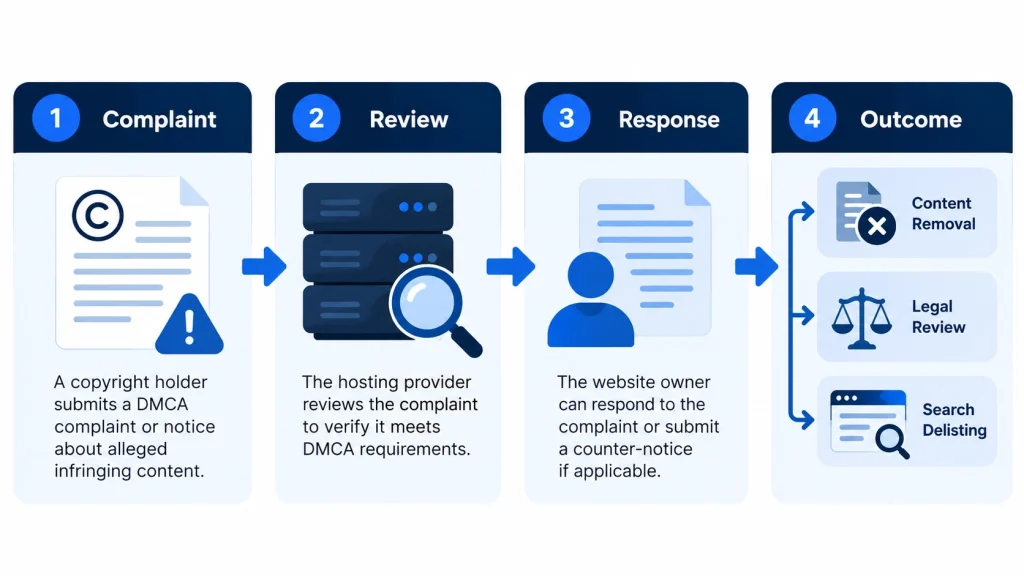
The notice-and-takedown process generally works as follows:
- Copyright complaint: A copyright owner or authorized representative submits a notice identifying allegedly infringing material.
- Provider review and action: A qualifying hosting provider acts expeditiously to remove or disable access to the reported material to preserve applicable safe-harbor protections.
- User notification: The provider notifies the affected user when required under the process.
- Counter-notification: If the material was removed by mistake or misidentification, the user may submit a legally compliant counter-notice.
- Possible restoration: Under the statutory process, content may be restored after 10–14 business days unless the complainant takes the specified legal action.
The DMCA doesn’t automatically establish that every reported copyright claim is valid.
For example, a website may have permission to publish a photograph, or a particular use may qualify for a copyright exception.
The notice-and-counter-notice process provides a way to address certain disputes, although complex cases may require legal advice.
How Does DMCA Ignored Hosting Work?
The distinction usually involves the hosting provider’s jurisdiction and complaint-handling policies.
Some providers outside the United States don’t follow the U.S. DMCA’s notice-and-takedown process as their default procedure.
Instead, they may assess complaints according to their country’s copyright laws, contractual terms, or applicable court orders.
However, hosting providers cannot simply declare themselves exempt from every form of copyright enforcement.
Whether legal action is possible depends on several factors, including where the provider operates, where the website’s activities occur, and which laws apply.
A company advertising DMCA ignored hosting may therefore have fewer automatic responses to U.S. copyright notices without offering any meaningful protection from legitimate legal claims.
Is DMCA Ignored Hosting Legal?
The hosting model itself isn’t necessarily illegal. Its legality depends on the provider’s conduct, applicable laws, and the content being hosted.
The DMCA is U.S. legislation and doesn’t automatically govern every company operating in another country.
However, most countries have their own copyright laws, and certain activities may also create legal exposure in multiple jurisdictions.
For example, European Union countries operate under European and national copyright frameworks. The EU’s Digital Services Act also establishes notice-and-action responsibilities for covered hosting services.
Consequently, moving a website to a foreign server doesn’t automatically make unauthorized movies, software, music, or other copyrighted works lawful to distribute.
Server location is not a substitute for obtaining the necessary content rights.
DMCA Ignored Hosting vs Offshore Hosting
These terms are frequently confused, but they describe different things.
| Hosting Type | What It Means |
|---|---|
| Offshore hosting | Hosting infrastructure located outside a particular country |
| DMCA ignored hosting | A provider that advertises a policy of not automatically honoring U.S. DMCA notices |
| Conventional hosting | Hosting operated under applicable laws and provider copyright policies |
An offshore provider may fully cooperate with copyright complaints, while a provider advertising DMCA ignored hosting may still remove infringing content.
Offshore hosting also has many legitimate purposes, including geographical performance, data residency, and business expansion.
It shouldn’t automatically be associated with piracy or weak copyright enforcement.
What Are the Risks of DMCA Ignored Hosting?
Although some providers advertise greater freedom from takedown requests, website owners should understand several important risks.
1. Copyright Liability
Hosting content in another country doesn’t eliminate responsibility for copyright infringement.
Rights holders may pursue legal remedies under applicable laws, including court orders or claims against parties involved in distributing unauthorized material.
2. Website and Service Availability
A provider may receive legal demands, suspend accounts under its own policies, or become subject to infrastructure-level restrictions.
Other services involved in delivering a website, such as domain registrars and CDN providers, may also have independent copyright and acceptable-use policies.
3. Search Engine Visibility
Google can remove specific URLs from search results after reviewing valid copyright removal requests, even if the hosting provider leaves the underlying content online.
This differs from automatically penalizing every website that uses a particular hosting category.
4. Provider Reliability and Transparency
Marketing claims about ignoring DMCA notices don’t establish server reliability, security quality, or customer privacy.
Website owners should evaluate a provider’s legal identity, service terms, infrastructure practices, and complaint procedures rather than relying on the label alone.
What If You Receive a Copyright Complaint?
Not every copyright complaint indicates intentional infringement.
A website owner may receive a notice involving incorrectly identified content, licensed material, or a disputed use.
If you receive a complaint:
- Review the notice: Identify the reported URLs, copyrighted works, and specific allegations.
- Verify your rights: Check licenses, permissions, ownership records, and any relevant copyright exceptions.
- Respond appropriately: Remove unauthorized material where necessary or contact the provider if you believe the claim is mistaken.
- Consider legal advice: If a formal counter-notification or legal dispute is involved, understand the potential consequences before proceeding.
Under the U.S. DMCA process, a formal counter-notice involves legal declarations, contact details, and consent to specified court jurisdiction. It should not be submitted casually.
The goal should be to resolve valid complaints while protecting lawful content from mistaken removal.
Does DMCA Ignored Hosting Affect SEO?
The hosting label alone isn’t a known Google ranking factor.
However, websites distributing infringing content may experience reduced search visibility if specific URLs are removed following copyright complaints.
Google maintains its own copyright removal procedures independently of hosting providers.
A hosting company declining a takedown request therefore doesn’t prevent a search engine from acting on a valid complaint.
For legitimate website owners, reliable infrastructure, technical accessibility, and useful original content remain much more relevant to long-term search performance than a provider’s DMCA marketing claims.
Frequently Asked Questions
No. Hosting providers cannot guarantee legal protection for unauthorized copyrighted material. Applicable local laws, cross-border legal claims, and court orders may still affect the website.
The DMCA is U.S. law, but activities involving international websites can sometimes fall within U.S. jurisdiction. Other countries also have copyright laws and enforcement procedures.
A provider isn’t automatically required by the DMCA to remove content merely because it receives a notice. However, failure to follow applicable procedures may affect its legal protections, and other laws or orders may require action.
No. Offshore hosting describes the location of infrastructure relative to a particular country. DMCA ignored hosting describes an advertised approach to certain copyright complaints.
Google can delist specific URLs from its search results after valid copyright complaints. Removing a URL from search results doesn’t necessarily remove the underlying content from the hosting server.
Conclusion
DMCA ignored hosting is often presented as a way to avoid copyright takedowns, but the reality is more complicated.
The term describes a provider’s advertised response to U.S. DMCA notices, not an exemption from copyright law.
Different countries have different legal procedures, and legitimate disputes over copyright ownership or permitted use deserve careful consideration.
Ultimately, no hosting location or marketing label guarantees immunity from copyright enforcement. Understanding the relevant laws and respecting content rights is more important than relying on promises that takedown notices will be ignored.